
A material only proves itself once it survives outside the lab.
Over the years, I have worked with established companies across very different industries, testing new materials in applications where performance cannot simply be assumed. From impact and penetration testing for a leading helmet manufacturer, to emissions testing for a caravan and motorhome manufacturer, and from components for one of the world's largest train manufacturers, to applications in life-saving equipment and shower tray production.
The industries may be different, but the challenge is remarkably similar. Every application comes with its own standards, conditions and demands, and ultimately the question is always the same: can this material replace what is already there without compromising performance? Then comes the question that matters even more, what happens when you push it beyond the conditions it was designed for?
Passing that test is only half the answer. A material also has to make sense to produce, at a cost that holds up and at a scale a real manufacturer can actually run. That is a different kind of proof, the kind you can only get by building it first. That part of the process lives on Prototype development.
Here are some of the tests, applications and results.
If your project needs this kind of proof before it goes into production, let's talk.
motorcycle helmet
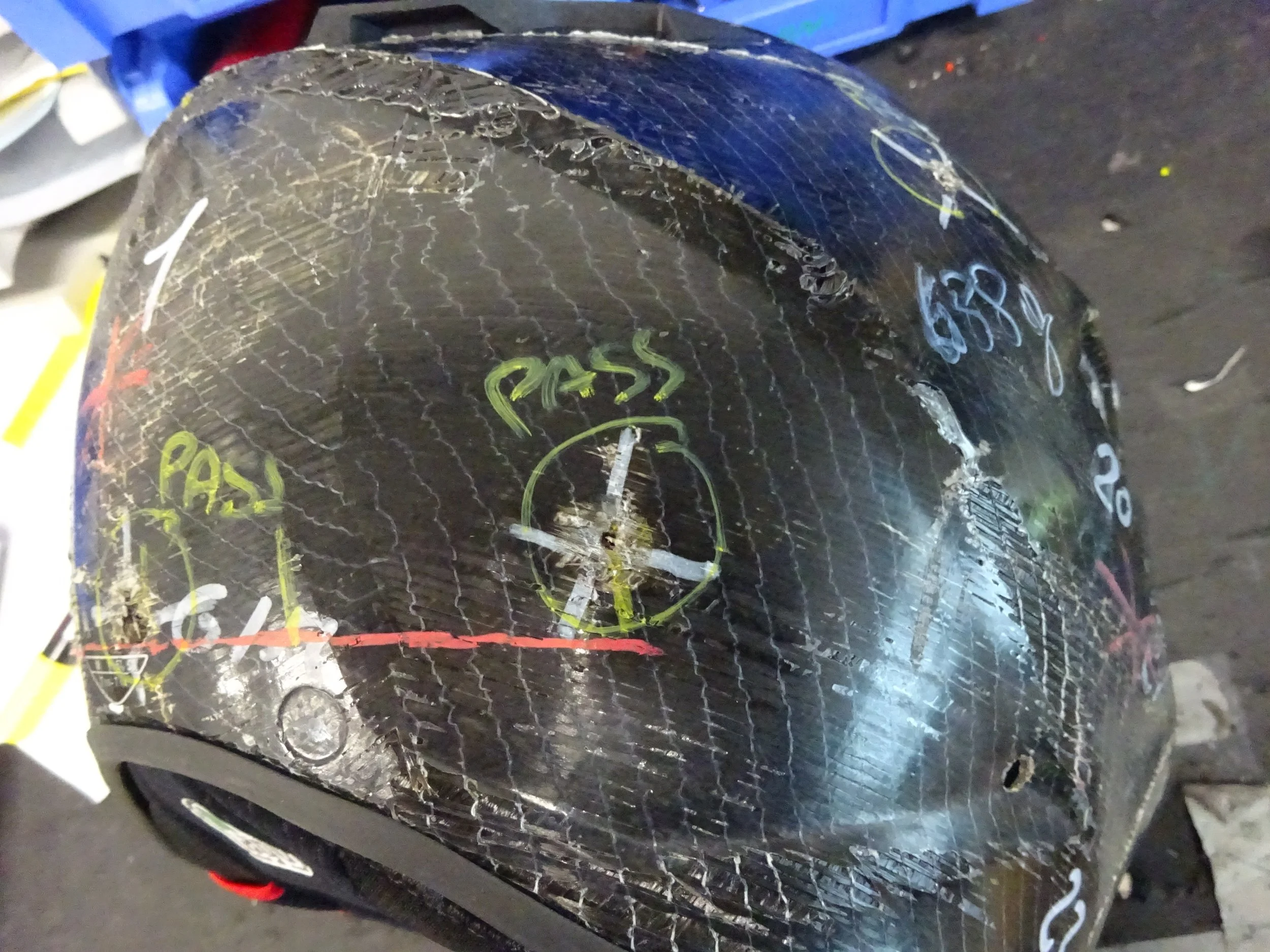
I built a series of three complete helmet shells using my composite material for a leading helmet manufacturer, and put them through ECE 22.05 penetration and kerbstone impact testing, the same tests any certified racing helmet has to pass. Each shell was tested at five fixed penetration points, always the same five, so the only variable between tests was the shell itself, not the test.
Of the fifteen penetration tests run across the three shells, thirteen passed. Two points failed, one on the first shell, one on the second. The third shell passed all five. Kerbstone impact was tested separately, across five zones defined by the standard, at 50 degrees Celsius and 7.5 metres per second, the same conditions a racing crash would actually produce.
Alongside the results, the material itself came in 14% lighter than the standard alternative at matching protection levels. And proving it was only half the job, the first prototype took four hours to produce. By the time production was standardised, that had come down to fifteen minutes per shell.
This is what proving a material actually means. Not a claim on a data sheet, a shell that either stops a cone or it doesn't, at a weight and a speed that can actually go into production.
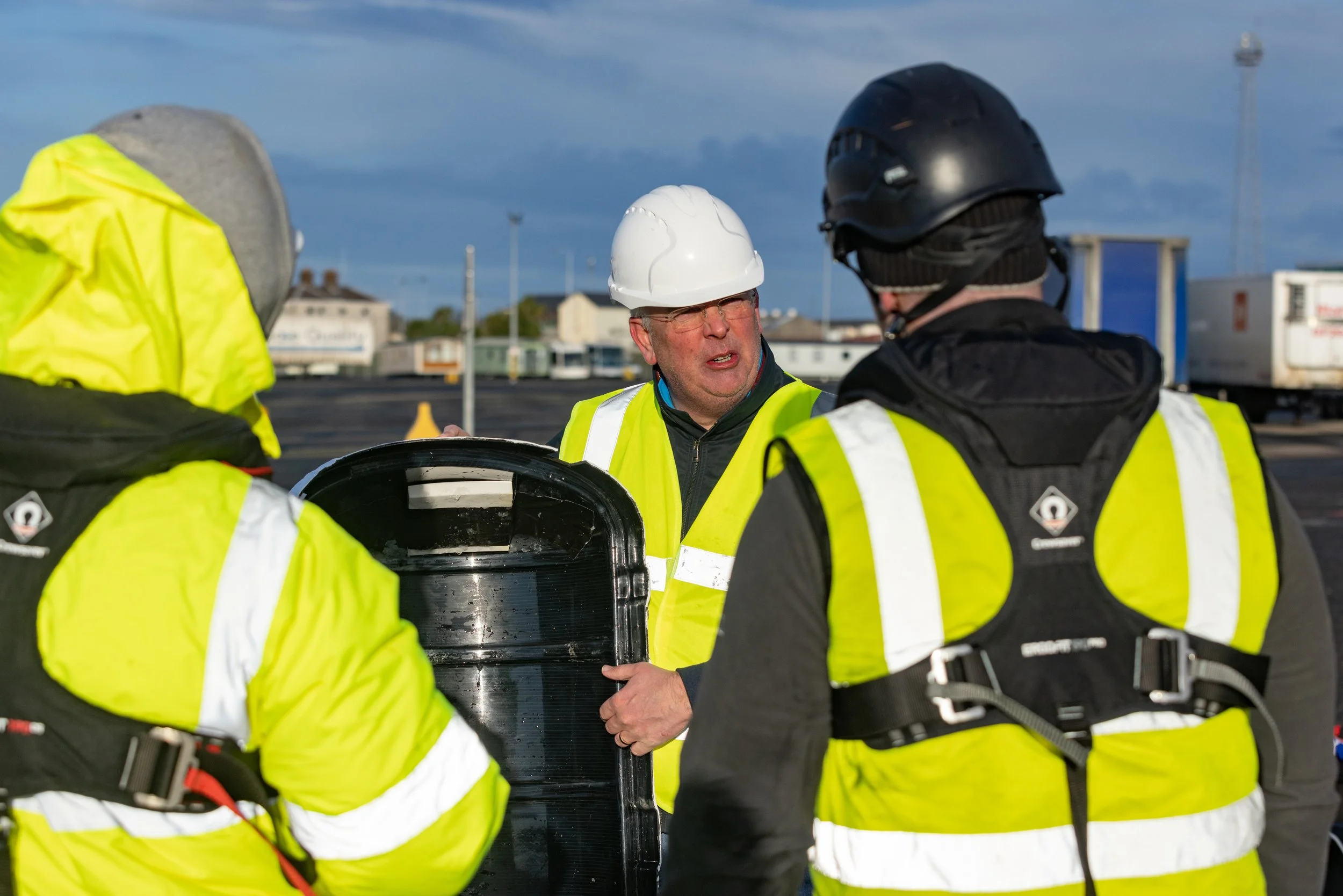
life raft container
A leading maritime safety manufacturer builds life-saving equipment used across the maritime industry, including the standard life raft containers found on commercial vessels worldwide.
The international drop test standard for a life raft container requires an 18 metre drop, onto a hard surface, container closed, raft inside. We tested a container built from my circular composite material at 36 metres, double the requirement, with a peak impact force of 52.96 kN, roughly 5,400 kg of force on landing.
It passed. The two halves stayed aligned on impact, where the existing glass fibre design did not. The exterior showed less damage, and the interior had no sharp edges or splinters that could have damaged the raft itself.
INDOOR AIR QUALITY
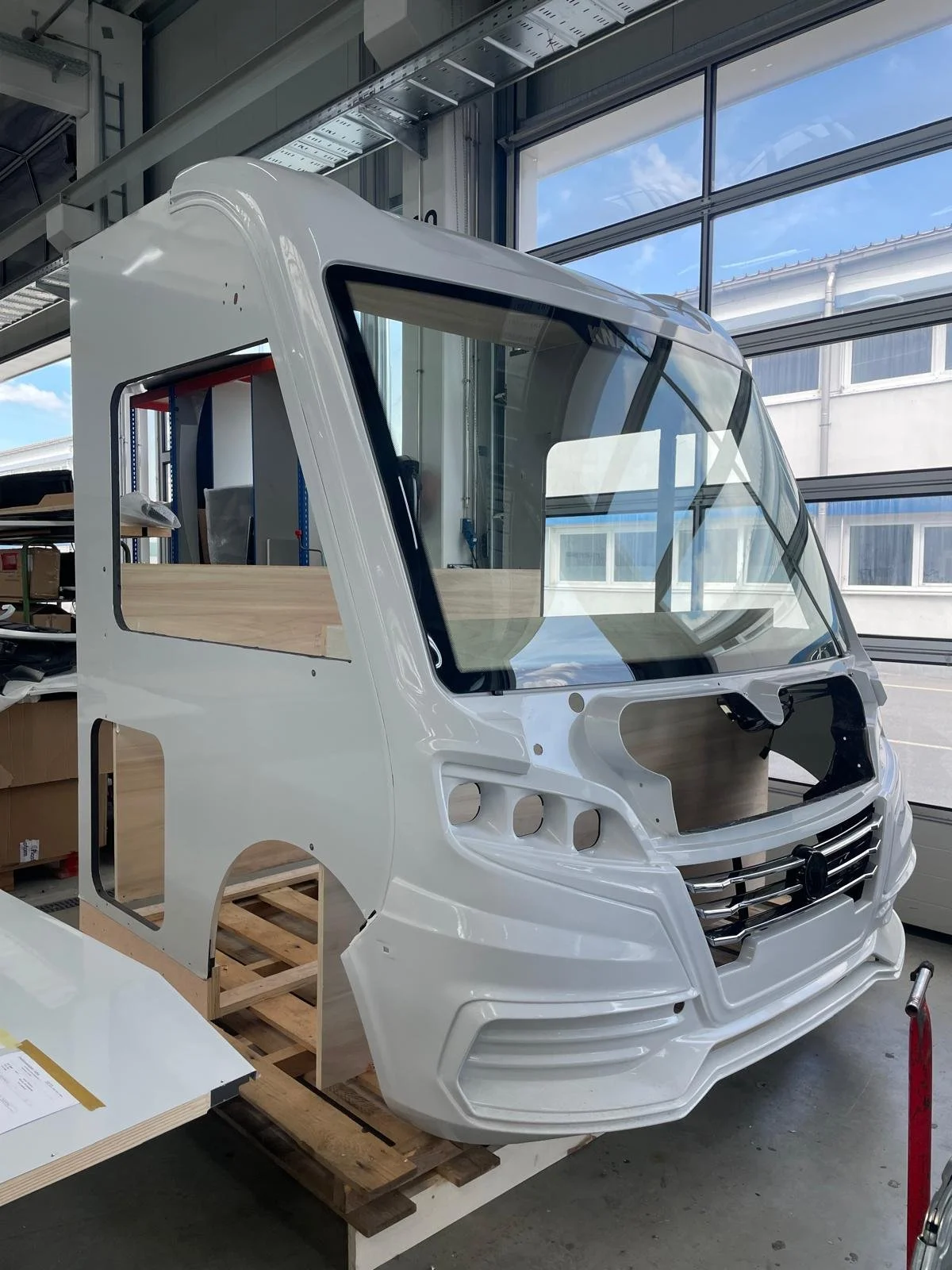
A German caravan and motorhome manufacturer builds living spaces where air quality matters more than almost anywhere else, small, enclosed, and slept in.
An early development panel was tested by an independent testing institute, using accredited analysis to DIN EN 16516 and ISO 16000, in March 2026.
Every individually regulated VOC, aldehyde and NIK substance came in well within the RW1 and RW2 limits. Several, including formaldehyde and acetaldehyde, were not even detectable above the quantification limit.
The R-value, a combined measure of health risk from the substances found, came in between 0.30 and 0.36 depending on the scheme used, comfortably under the 1.0 threshold required to pass.
The one figure that ran close was TVOC under AgBB 2024, 310 micrograms per cubic metre against a 300 microgram target, essentially at the line. Post curing is expected to bring that down further.
SHOWER TRAY
A manufacturer of products for assisted living, has been designing and building these products since 1990.
Steel-reinforced shower trays are heavy for a reason. Rebuilding one without steel meant proving the composite alone could take the load.
The original tray weighed 22.7 kg. Removing the steel reinforcement entirely and optimising the composite layup brought that down to 9.8 kg, a 56.8% weight reduction.
That is not just a lighter product on paper. The steel-reinforced tray needed two people to install. This one, one person can carry and fit alone.
The puncture resistance requirement for this application is a 250 kg cone dropped from 1 metre. The composite tray passed with a 1,000 kg cone from the same height, four times the requirement.
We also worked with faster curing resins and changed the production method. The same mould now produces two trays a day instead of one.
FIRE, SMOKE & TOXICITY for railway
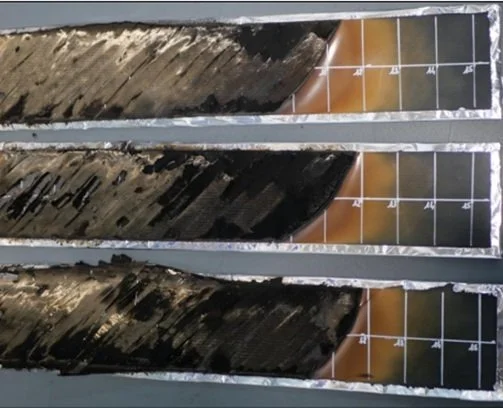
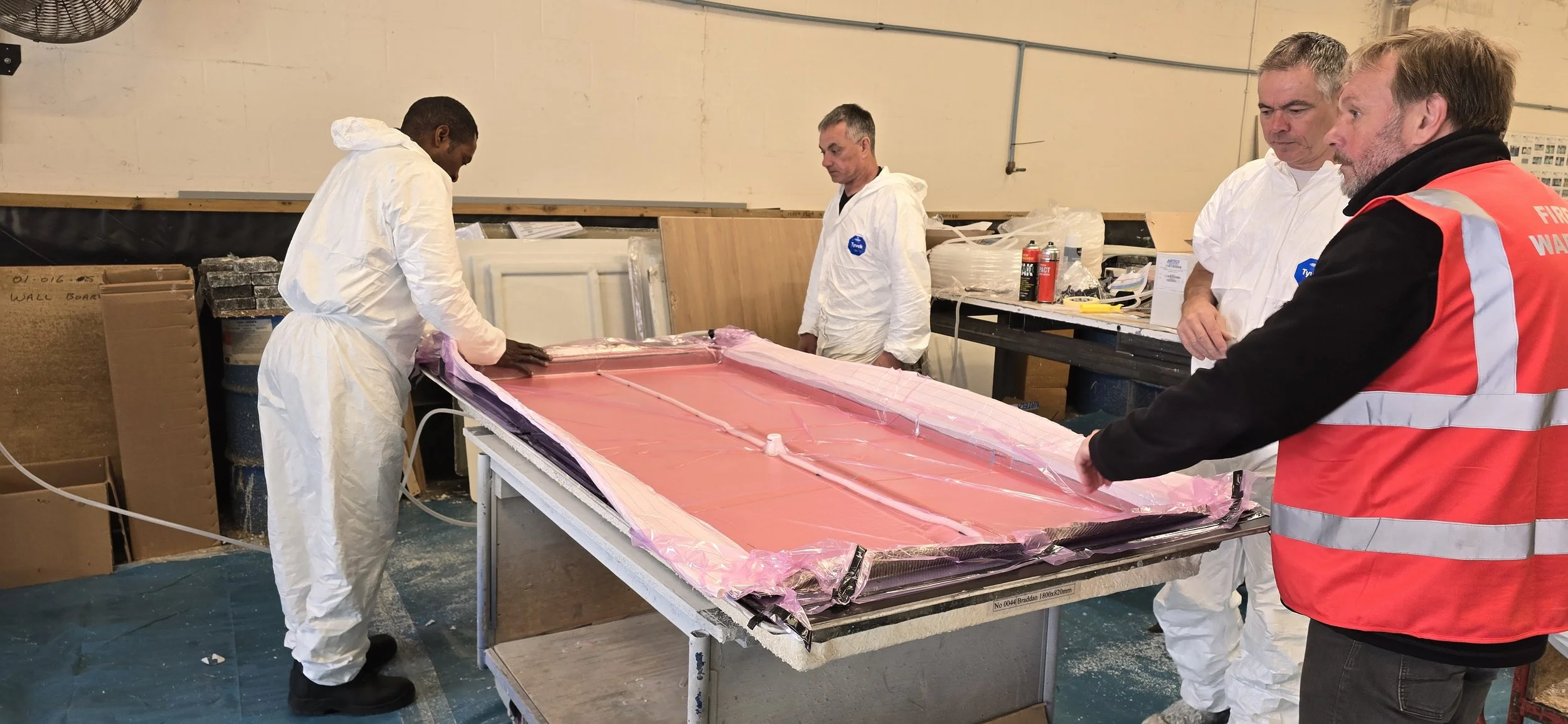
A major train manufacturer tested materials for use inside train interiors against EN 45545-2, the European rail standard for fire, smoke and toxicity behaviour, requirement level R17, one of the hardest bars a composite material has to clear before it's allowed anywhere near a passenger cabin.
Two gelcoat variants were tested, one with ATH flame retardant, one without. Heat release, measured as MARHE, and smoke toxicity, measured as ITCg, both performed strongly on both samples. Smoke density, Dsmax, reached HL2 level on both, a solid result for an early development panel.
Spread of flame, CFE, is the one figure still short of the HL1 threshold, and it happens to be the property most directly tunable through the resin system and surface treatment rather than the fibre layup itself. That's where the next development round is focused.
The material was also independently tested for recyclability. A 920 gram sample was broken down through thermal recycling. 56% came back as reclaimed fibre and powder, 17% as recovered crude oil, the rest as process gas. More than 75% of the recovered oil consisted of methyl methacrylate and benzoic acid, both chemicals with real market value on their own.
That means the material does not just perform inside the train. At the end of its life, it comes apart into something worth reusing, not landfill.